The Uninsured Majority: Rethinking Insurance for Emerging Markets
- admin
- November 18, 2026
- Business, Consulting
- 0 Comments
The Uninsured Majority
Rethinking Insurance for Emerging Markets
Insurance remains out of reach for much of the world’s population. Across emerging economies, billions of households and small businesses are exposed to financial shocks from illness, accidents, and climate events, and only 8% of the population in emerging markets has any form of insurance.
But the protection gap is also an opportunity to rethink how insurance works. Technology, innovative business models, and partnerships across the public and private sectors are making it possible to reach customers who have historically been excluded from traditional insurance markets.
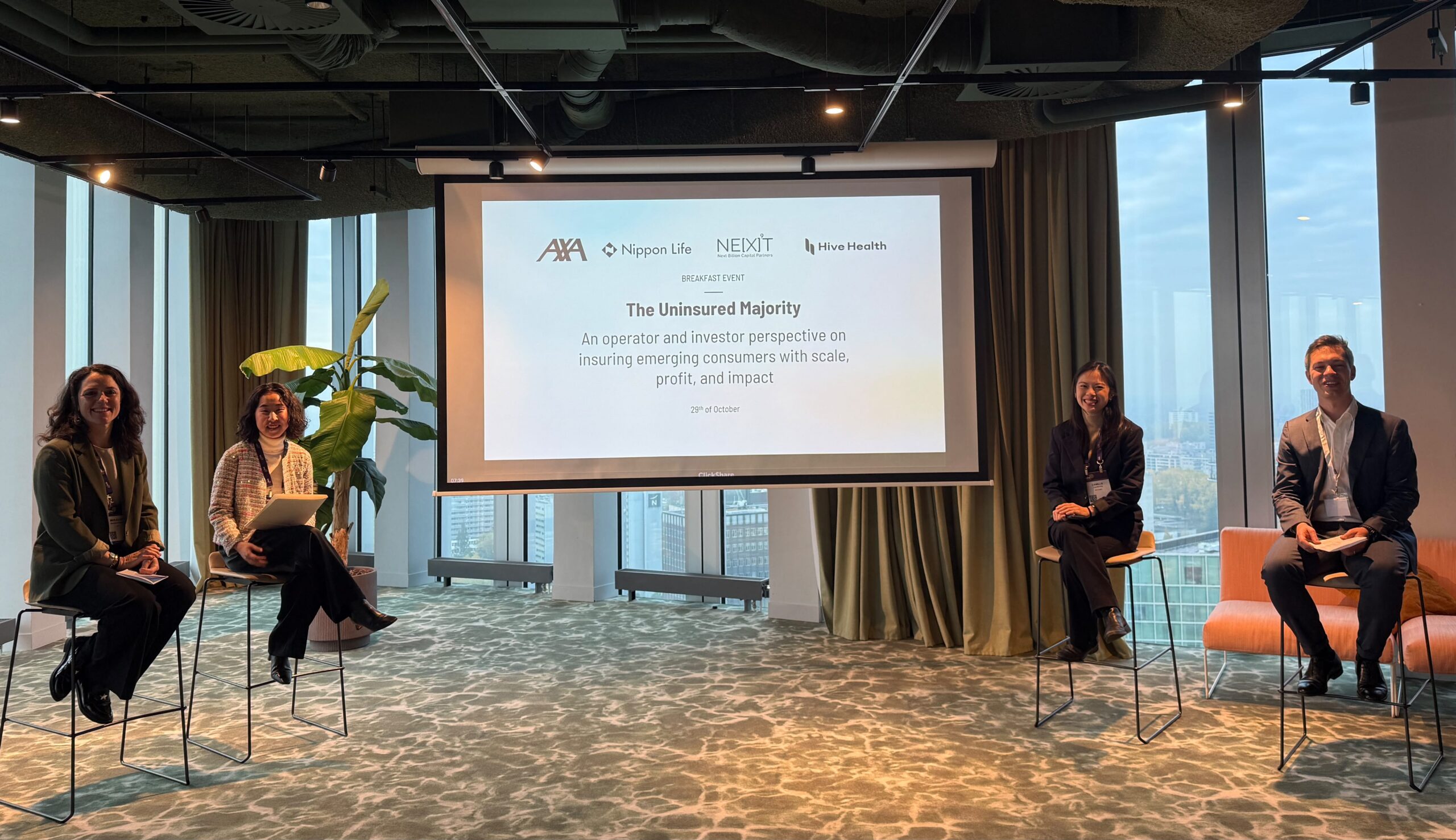
On October 29, alongside the Global Impact Investing Network’s Impact Forum in Amsterdam, Next Billion Capital Partners and AXA EssentiALL co-hosted The Uninsured Majority, a discussion bringing together perspectives from global insurers, entrepreneurs, and institutional investors.
The panel featured Marjolaine Chaintreau of AXA EssentiALL, Camille Ang of Hive Health, Saya Mizuno of Nippon Life Global Investors Americas, and Eduard Melli of Next Billion Capital Partners.
The conversation explored the barriers to insurance inclusion, the role of technology in overcoming them, how collaboration can help extend financial protection to underserved populations, and the role of insurance companies as asset owners in investing patient capital to pursue positive outcomes.
Why the uninsured majority remains underserved
Traditional insurance products and distribution systems were largely designed for affluent customers and established businesses. High acquisition costs, complex policies, fragmented infrastructure, and limited consumer trust have made it difficult to serve lower-income households and smaller enterprises sustainably.
Hive Health offers an example of how this is changing. The Philippines-based company uses technology and data to provide comprehensive healthcare coverage to small and medium-sized businesses, a segment historically overlooked by traditional insurers.
Approximately 40% of Hive Health’s customers had never previously held an HMO (Health Maintenance Organization) plan or comprehensive health insurance. By combining digital infrastructure with a deep understanding of local healthcare needs, Hive Health is reaching customers that traditional providers have struggled to serve.
For established insurers, the challenge is equally significant. AXA EssentiALL, the global insurer’s inclusive insurance business, reached 20.6 million customers across 21 markets in 2025. Its approach focuses on making insurance affordable, attractive, and accessible through simplified products and distribution channels that underserved populations already use and trust.
Technology changes the economics of insurance
Digital distribution, automation, and artificial intelligence are changing the economics of underwriting, distributing, and servicing insurance policies. For companies targeting underserved customers, these efficiencies are critical. Lower operating costs make it possible to offer smaller policies, reach customers in previously uneconomical markets, and expand coverage without a proportional increase in expenses.
Beyond operational efficiencies, it is important to focus these new technology capabilities as a key differentiator in improving customer experience, understanding of financial services and promoting financial literacy for customers’ financial health and resilience.
Next Billion’s portfolio company Qoala illustrates this opportunity. Across Southeast Asia, Qoala is using AI to automate documentation, claims processing, and fraud detection, reducing servicing costs while improving customer and agent experience.
Technology alone, however, cannot overcome every barrier. Reaching new customers also requires trusted distribution networks, supportive regulatory frameworks, and products designed around local needs.
Partnerships are essential to expanding access
A central theme of the discussion was the role of partnerships among governments, insurers, corporations, and entrepreneurs in building more inclusive insurance markets.
In the Philippines, Hive Health has worked with the Insurance Commission on a regulatory sandbox framework that enables innovative insurance models to operate. The company has also collaborated with the regulator on developing new micro-HMO products designed to expand access to healthcare coverage.
Hive Health is also working with PhilHealth, the country’s national health insurer, to better coordinate public and private health benefits. By reducing overlapping coverage and allowing private plans to complement government benefits, this approach can help maximize the value of healthcare spending for patients.
For global insurers, partnerships are equally central to reaching underserved populations at scale. AXA EssentiALL works with 183 partners, including financial institutions, digital platforms, employers, and community organizations, to bring insurance products to customers through channels they already use.
These relationships enable companies to combine the reach and infrastructure of established institutions with the innovation and local knowledge of emerging businesses. Effective collaboration can create new markets, improve coverage, and extend protection to populations that neither sector could efficiently serve alone.
The role of institutional capital and long-term impact
The discussion also included the perspective of Nippon Life, which operates life insurance and asset management businesses in the Asia-Pacific region and globally, and is the largest private asset owner in Japan.
When considering that insurance companies globally hold roughly $39tn in assets (17% of total non-bank assets), and by design, especially with life insurance, can act with longer durations and as patient capital, they play a very important role in achieving the UN SDGs.
Nippon Life started its journey within impact since its founding more than 130 years ago, advocating the principle of contributing to the stability and enhancement of people’s lives.
After the Japanese government first introduced the guidelines for impact investing in 2020, Nippon Life set a dedicated target for its investment allocation to impact investing, as part of a broader sustainable investment strategy that includes a sustainability-focused Fund of Funds.
AXA also articulates its commitment as an investor, 10 years after the Paris Agreement, its priority now is to accelerate the transition to a low-carbon economy and focus on resilience. In 2025, EUR 6.4bn was invested to finance the climate transition and more than EUR 1.4bn for community resilience globally.
The takeaway
Closing the insurance protection gap requires more than extending existing products to new customers. It calls for rethinking how insurance is designed, distributed, financed, and delivered.
The discussion in Amsterdam brought together different parts of that equation: entrepreneurs developing new business models that make it possible to serve previously excluded customers and MSMEs, global insurers investing resources and capital in launching and scaling inclusive insurance, institutional investors bringing a long-term perspective to capital allocation, and growth-stage investors backing technology solutions that create new distribution channels, allow insurers to serve thin-file customers, and offer insurance policies that are more affordable, attractive, and accessible.
Across emerging markets, these efforts are demonstrating how technology and partnerships can make insurance accessible to people and businesses historically excluded from traditional markets.


